

2026 London House Price Forecast: Top Areas for Growth
2026 London Property Price Trends: The Complete Report — A Deep Analysis of the Top Growth Areas Over the Next 5 Years, Essential Reading for Overseas Buyers
Introduction: The Moment the Acceptance Letter Arrives
The moment your child receives their offer letter from a London university, a single question crystallises in your mind before the celebration has even begun: should we rent, or should we buy? For high-net-worth families across Taiwan, Hong Kong, Mainland China, and Singapore, this is not merely a logistical question — it is the opening move in a significant cross-border asset allocation decision, one that will shape your family’s financial position in the United Kingdom for years to come.
In 2026, the London property market presents a confluence of signals that demand careful, data-driven attention. Three in particular stand out. First, the market has decisively shifted from a seller’s market to a buyer’s market, meaningfully expanding negotiation leverage for well-prepared purchasers — a window of opportunity that has been rare in recent years. Second, whilst London’s median property price sits at approximately £500,000 to £505,000, the variance between individual boroughs is so extreme that selecting the right area matters far more than selecting the right moment. Third, and perhaps most critically, Savills forecasts that London property prices will achieve a cumulative growth of 13.6% between 2026 and 2030 — but this growth will be highly concentrated in specific corridors and boroughs, rather than distributed evenly across the capital.
This report will use the latest market data to precisely map the growth coordinates for the next five years, providing you with the analytical framework that institutional investors rely upon — applied directly to the decisions that matter most to your family.
- Book a 2026 London Property Consultation: Book Online
- Official Line: https://lin.ee/bkSsVsN
- Official WhatsApp: +44 7925 281228
- Official WeChat: IREIS_London
Reading the 2026 London Property Market: Three Essential Coordinates
Before identifying which specific areas are positioned to outperform, it is essential to establish a clear cognitive framework for understanding the market as it stands today. Experienced investors do not simply ask “where should I buy?” — they first ask “what is the structural logic of this market, and where does that logic point?” The following three coordinates provide that foundation.
Coordinate One: The Price Landscape and Its Profound Divergence
London is not one market. It is thirty-two borough markets, each operating with its own supply dynamics, demographic profile, and regeneration trajectory. The price divergence between boroughs is not merely significant — it is extraordinary. At the premium end, Kensington and Chelsea commands an average price of approximately £1.12 million, whilst Westminster sits at approximately £937,000. At the opposite end of the spectrum, Barking and Dagenham averages approximately £336,000 — less than a third of the price of prime central London.
This divergence is not a flaw in the market; it is the very foundation upon which value opportunities are built. For the discerning overseas investor, it means that genuine “value pockets” — areas where current pricing does not yet reflect future infrastructure investment, demographic shifts, or regeneration momentum — continue to exist within one of the world’s most liquid and transparent property markets.
It is also worth noting that London’s flat (apartment) market has seen average prices decline by approximately 7% since early 2023. For long-term investors, this represents a potential mean-reversion opportunity — assets that have been oversold relative to their fundamental rental income and location quality.
Coordinate Two: The Dual Pressure of Interest Rates and Affordability
The elevated interest rate environment of recent years has created a well-documented affordability squeeze for first-time buyers and domestic owner-occupiers. Mortgage costs have risen substantially, pushing a significant cohort of would-be buyers into the rental market indefinitely. Whilst this dynamic presents challenges for those seeking to purchase their own home, it creates a structurally supportive backdrop for investment-oriented buyers: rental demand across London remains exceptionally robust, underpinned by a population of renters who are unable, rather than unwilling, to purchase. This provides overseas investors with a reliable and sustained income stream that is not dependent on speculative demand.
Coordinate Three: London’s Underperformance Relative to the National Average — A Signal, Not a Warning
In 2025, London’s overall property prices declined by approximately 1.8%, underperforming the national average. For a short-term speculator, this might appear discouraging. For a long-term, strategically minded investor, the interpretation is precisely the opposite. London’s relative underperformance against the national index — in a city that has historically delivered superior long-run capital appreciation — represents a compression of relative value. The capital’s structural advantages: global financial centre status, world-class universities, a transparent legal system, and perpetual international demand, have not diminished. What has changed is the entry price. For overseas high-net-worth families with a five-to-ten-year investment horizon, this is the definition of a strategic entry point.
Five London Areas with the Strongest Growth Potential in 2026: A Deep Analysis
The following five areas have been identified through a synthesis of rental yield data, regeneration pipeline analysis, transport infrastructure investment, and third-party research from sources including Zoopla. Each represents a distinct investment thesis, allowing buyers to align their choice with their specific objectives — whether prioritising rental income, capital growth, or proximity to their child’s university or workplace.
Area One: Stratford and West Ham (E15) — The Elizabeth Line Dividend
The investment case for Stratford and West Ham is built upon one of the most powerful and well-documented forces in London property: transport infrastructure-led value uplift. The Elizabeth Line (Crossrail) has fundamentally repositioned East London’s connectivity, placing Stratford within 7 minutes of Canary Wharf and under 15 minutes of the City. This is no longer a speculative thesis — it is a proven reality that continues to attract young professionals who prioritise commute time above all else.
The ongoing redevelopment of the Olympic legacy site adds a further layer of long-term demand. New residential, commercial, and cultural developments continue to transform the area’s identity and desirability. Critically, the data supports the narrative: two-bedroom apartments in Stratford are generating rental yields of approximately 6.85%, whilst the broader E15 postcode delivers yields of approximately 5.8%. This combination of strong current income and credible capital growth potential makes E15 one of the most compelling dual-return propositions in the London market.
Area Two: Barking (IG11) — London’s Highest-Yield Opportunity
For investors whose primary objective is maximising rental income relative to purchase price, Barking presents a case that is difficult to overlook. As part of the Barking and Dagenham borough — where average prices sit at approximately £336,000 — the entry cost is among the lowest available within Greater London. Yet the rental yield profile is among the highest: Barking is generating rental yields of approximately 7.2%, placing it at the very top of the London yield spectrum.
The area’s regeneration pipeline is substantial and credible, with large-scale development schemes attracting young families and first-time renters who are priced out of more central locations. The combination of a low purchase price, a high yield, and a regeneration-driven demand outlook creates a risk-reward profile that is genuinely attractive for overseas investors seeking cash-flow-positive assets from day one.
Area Three: Tottenham (N17) — Urban Regeneration in Its Early Stages
Tottenham represents what experienced property investors refer to as an “early-stage regeneration premium” — the period during which physical transformation is underway, area perception is improving rapidly, but pricing has not yet fully reflected the destination the area is becoming. The catalyst is clear: the development of the Tottenham Hotspur Stadium and its surrounding masterplan has triggered a wave of new residential construction, infrastructure investment, and commercial activity that is systematically elevating the area’s profile.
Rental yields in Tottenham currently range from approximately 5.8% to 6.5%, reflecting a market that is already generating strong income whilst retaining meaningful upside as the regeneration premium continues to be released into capital values. For investors willing to look beyond established postcodes, N17 offers the kind of asymmetric opportunity — where the downside is limited by strong rental demand and the upside is driven by a credible, government-backed regeneration programme — that is increasingly rare in a city as well-researched as London.
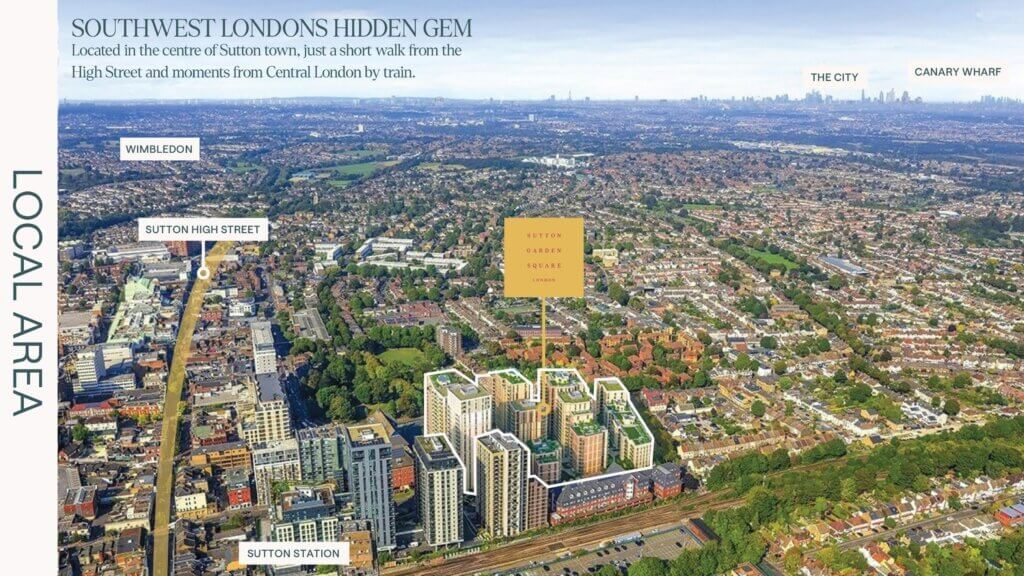
Area Four: Ilford, Sutton, and Uxbridge — The Zoopla-Identified Trio
Zoopla has explicitly identified Ilford, Sutton, and Uxbridge as three of the London areas with the strongest price growth potential in 2026. Whilst these three locations are geographically distinct, they share a common investment logic: each offers a price base significantly below the London median, each benefits from improving or well-established transport connectivity, and each is absorbing demand that is being displaced from more expensive neighbouring areas.
For overseas buyers, these areas represent what might be described as “London’s address at an outer-London price” — the opportunity to acquire an asset within Greater London’s administrative boundary, with access to London’s employment market and rental demand pool, at a price point that would be considered exceptional by any international comparison. As affordability constraints continue to push both buyers and renters outward from the centre, these three areas are structurally positioned to benefit from that migration.
Area Five: Walthamstow and Hackney — Established Gentrification, Sustained Demand
Unlike the earlier-stage regeneration plays, Walthamstow and Hackney represent a more mature investment thesis: areas that have already completed their gentrification transition and are now characterised by a stable, high-quality tenant base of educated young professionals. The risk profile is consequently lower, but the income reliability is higher. Rental growth potential in outer boroughs such as Walthamstow and Hackney is forecast at up to 6%, driven by sustained demand from tenants who value the areas’ independent culture, green spaces, and transport links into central London.
For overseas investors who prioritise low vacancy rates, reliable tenants, and predictable cash flow over speculative capital growth, these areas offer a compelling proposition. The tenant demographic — typically professionals in their late twenties and thirties with stable employment — aligns well with the requirements of the incoming Renters’ Rights Act, which we address in detail in the following section.
Critical Tax and Regulatory Boundaries Every Overseas Buyer Must Understand in 2026
A sophisticated investment strategy is not merely about identifying the right area — it is equally about understanding the regulatory and fiscal environment in which that investment will operate. The UK’s property tax and tenancy legislation has undergone significant change in recent years, and 2026 marks a particularly important inflection point. The following four areas demand careful attention from every overseas buyer.
Stamp Duty Land Tax (SDLT): The Non-Resident Surcharge
Non-UK residents purchasing residential property in England are subject to a 2% surcharge on top of the standard SDLT rates. To illustrate the practical impact, consider a purchase at the London median price of £500,000. Under the standard SDLT structure applicable to an additional property purchase, the base liability would already be substantial. The additional 2% non-resident surcharge on a £500,000 purchase adds a further £10,000 to the total tax cost. Overseas buyers must factor this into their total acquisition budget from the outset, as it is a non-negotiable cost that cannot be recovered at the point of sale.
We strongly recommend that all overseas clients obtain a precise SDLT calculation from a qualified UK solicitor prior to exchanging contracts, as individual circumstances — including residency status, existing property ownership, and purchase structure — can materially affect the final liability.
Capital Gains Tax (CGT): Planning Your Exit from Day One
The annual CGT exemption currently stands at £3,000 — a figure that has been dramatically reduced from its historical levels and offers limited shelter for property investors. For residential property disposals, the applicable CGT rates are 18% for basic-rate taxpayers and 28% for higher-rate taxpayers. For most overseas high-net-worth investors, the 28% rate will apply to the majority of any gain realised upon sale.
The practical implication is clear: CGT must be modelled as an explicit exit cost when calculating the net return on any London property investment. An asset that appears to offer a 30% capital gain over five years may deliver a materially lower net return once CGT, selling costs, and currency conversion are accounted for. Professional tax planning — ideally established before the purchase completes — is not optional; it is a fundamental component of a well-structured investment.
The Renters’ Rights Act 2025: A Structural Shift in Landlord-Tenant Dynamics
Perhaps the most significant legislative development affecting London’s buy-to-let market is the Renters’ Rights Act 2025, which begins its phased implementation from 1st May 2026. The Act’s most consequential provision is the abolition of Section 21 “no-fault” evictions, which has historically allowed landlords to recover possession of their property without providing a specific reason. Under the new framework, all tenancies will transition to open-ended periodic tenancies, and landlords will be required to demonstrate one of the prescribed grounds for possession under Section 8.
Additionally, the Act prohibits rental bidding wars — a practice that had become commonplace in high-demand London markets — which may moderate the pace of rental growth in some areas. For overseas investors managing properties remotely, the implications are significant: the quality of tenant selection and the competence of the managing agent become substantially more important under a regime where recovering possession is more procedurally complex. This is not a reason to avoid the market — rental demand remains structurally strong — but it is a compelling reason to invest in properties that attract high-quality tenants and to engage professional, regulated property management from the outset. As we discuss in the following section, new build properties are inherently better positioned to meet these requirements.
Leasehold Reform: Why the Tenure Structure of Your Purchase Matters
The Leasehold and Freehold Reform Act 2024 has already prohibited the creation of new leasehold houses (with limited exceptions), and 2026 is expected to see further progress towards establishing Commonhold as the default tenure for new-build apartments. This is a structural shift of considerable importance for overseas buyers.
Traditional leasehold tenure — which has historically been the standard for London flats — carries well-documented risks: escalating service charges, ground rent disputes, and the gradual erosion of lease length (and therefore asset value) over time. These risks are particularly acute for overseas owners who cannot monitor their property’s management company closely. New build properties, by contrast, are being developed under the new legislative framework, offering more transparent ownership structures, clearer service charge accountability, and protection from the legacy issues that afflict older leasehold stock. This is a structural advantage that no amount of renovation can confer upon an older second-hand flat.

Why New Build Properties Are the Optimal Solution for Overseas Investors Navigating These Risks
Having established the market opportunity and the regulatory landscape, a logical question emerges: given all of the above, what type of property best serves the needs of an overseas high-net-worth buyer who cannot be physically present to manage their investment? The answer, when examined through the lens of each specific risk identified in this report, consistently points to one conclusion: a new build property from a reputable London developer.
Concerned About Tenant Management Under the New Renters’ Rights Act?
Quality new build developments in high-demand areas — precisely the regeneration zones identified in this report — naturally attract a higher calibre of tenant: young professionals with stable incomes who value modern amenities, energy efficiency, and well-managed communal spaces. Furthermore, many reputable developers offer integrated lettings and property management services, providing overseas owners with a single point of accountability and professional compliance with the new legislative requirements. In a post-Section 21 world, the quality of your tenant is your most important risk management tool — and new builds are structurally better positioned to attract that quality.
Concerned About Leasehold Disputes and Service Charge Opacity?
New build properties developed under the post-2024 legislative framework offer precisely the transparent ownership structures and accountable service charge arrangements that the Leasehold Reform Act was designed to mandate. Purchasing a new build means you are acquiring an asset that is compliant with current standards by design — not one that requires retrospective legal remediation. For an overseas owner managing their investment from thousands of miles away, this structural clarity is not a luxury; it is a necessity.
Concerned About Buying Into a Market That Fails to Appreciate?
The areas identified in this report as having the strongest growth potential — Stratford, Barking, Tottenham, Ilford, and their peers — are, without exception, areas of active new build development. This is not a coincidence. Developer investment is itself one of the most reliable leading indicators of area-level value appreciation. When a major developer commits capital to a location, they are making a statement about that area’s trajectory that is backed by substantial due diligence. Purchasing a new build in these areas means aligning your investment with the same regeneration momentum that the developers themselves have identified.
Concerned About Remote Property Management and Unexpected Repair Costs?
New build properties in England typically come with a 10-year NHBC (National House Building Council) structural warranty, providing comprehensive protection against major defects during the period when unexpected costs are most likely to arise. Combined with the manufacturer warranties on fixtures, fittings, and appliances that are standard in new developments, this dramatically reduces the financial exposure of an overseas owner who cannot personally oversee maintenance. For a family whose primary concern is their child’s welfare and education — not boiler emergencies at 11pm — this peace of mind has genuine, quantifiable value.
Conclusion: Precision, Not Speculation, Is the Strategy for 2026
The 2026 London property market is one defined by three simultaneous forces: deepening divergence between boroughs, the emergence of genuine value pockets in regeneration corridors, and a regulatory environment that is fundamentally reshaping the rules of engagement for landlords and investors alike. For overseas high-net-worth families, the era of simply buying anywhere in London and expecting the market to do the work is over. What replaces it is a more demanding, but ultimately more rewarding, discipline: precise area selection, rigorous tax planning, and deliberate product choice.
The families who will look back on 2026 as a defining moment in their UK asset allocation will be those who resisted the temptation to follow the crowd into overpriced prime central postcodes, and instead applied institutional-quality analysis to identify the areas — and the property types — that are structurally positioned to outperform over the next five years.
IREIS exists to provide exactly that quality of analysis, tailored to your family’s specific circumstances — whether your child is studying at UCL, working in Canary Wharf, or beginning a career in the City. We invite you to take the next step in two ways. First, download our 2026 London Investment Area Scorecard — a proprietary analytical tool that rates each of the key growth areas against the metrics that matter most to overseas investors. Second, and most importantly, book a complimentary one-to-one consultation with an IREIS senior consultant, who will build a bespoke property strategy around your child’s location, your investment objectives, and your family’s long-term vision for UK asset ownership.
- Book a 2026 London Property Consultation: Book Online
- Official Line: https://lin.ee/bkSsVsN
- Official WhatsApp: +44 7925 281228
- Official WeChat: IREIS_London
Disclaimer: The 2026 UK property market trends, tax, and regulatory information provided in this article are for reference purposes only and do not constitute investment or legal advice. UK regulations and tax systems are subject to change. For actual transactions, please consult professional advisors at IREIS and registered UK solicitors and accountants.
Related guides
Featured developments
Prefer to see them in person? Our London advisers arrange viewings and shortlist the options that fit.

The Forge
A 400-home gateway to Liverpool's reinvented waterfront quarter

Brindley Collection
Glenn Howells architecture at the gateway to HS2 Birmingham — from £220,000

Urban Picturehouse
Art Deco heritage meets contemporary living on the doorstep of Southeastern rail

London-based, trilingual UK property advisers for overseas and domestic buyers. Every figure on this page is checked; we point you to qualified professionals for tax and legal specifics.
Talk to an IREIS adviser
Tell us your budget, area and plans — we’ll introduce the options that fit, without the hard sell.


On desktop? Scan with your phone to start the conversation.